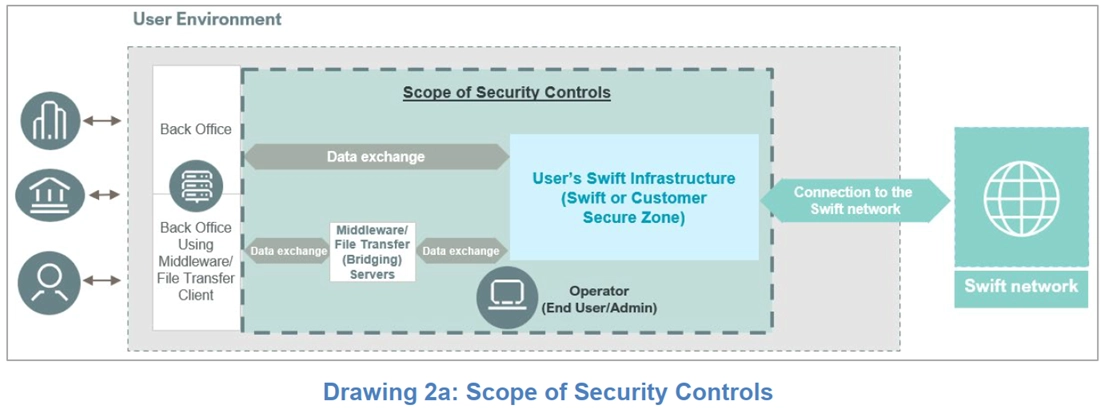
Back Office Data Flow Security Is Now Mandatory
Perhaps the most impactful change is that Control 2.4 – Back Office Data Flow Security has moved from advisory to mandatory status.
This control focuses on securing the data exchanges between a user’s secure zone and back-office systems, particularly when the data isn’t protected end-to-end.
In 2026, institutions must ensure:
SWIFT has also outlined a phased roadmap toward 2028, when all remaining legacy data flows will be brought under full compliance.
Takeaway: Start validating your data transfer architecture now—especially middleware and file transfer layers—to ensure readiness for full enforcement.
Customer Client Connectors Now In-Scope for Multiple Controls
The concept of “customer client connectors”—such as file transfer clients, middleware, or API endpoints—has been expanded.
Previously advisory, these components are now mandatory in-scope for numerous key controls, including:
This aligns all user endpoints—both servers and clients—under a single, standardized security expectation.
Impact: Organizations that previously self-classified as Architecture Type B (no Swift footprint) may now need to attest under Type A4, which includes customer connectors.
Alliance Connect Evolves to Software-Defined Networking
Between 2026 and 2028, SWIFT will transition its Alliance Connect portfolio to Software-Defined Wide Area Network (SD-WAN) technology.
A major innovation is the introduction of the Alliance Connect Virtual on Premises VPN, a virtual VPN solution deployed on the customer’s own virtual machine.
This new VPN model is explicitly in scope for multiple CSCF controls, ensuring that institutions adopting it maintain equivalent levels of security as with traditional hardware (SRX) or cloud-hosted VPNs (vSRX).
Why this matters: The move reflects SWIFT’s long-term shift toward virtualized and cloud-compatible connectivity models, aligning with broader industry modernization trends.
Control Clarifications and Enhancements
The 2026 update refines several existing controls, improving clarity and implementation consistency:
Bottom line: v2026 focuses less on new controls and more on improving the precision, consistency, and modern relevance of existing ones.
Updated Scope and Terminology
Several definitions and scope boundaries have been updated to reflect evolving technologies and deployment models:
In short: SWIFT is making the framework more reflective of modern financial infrastructures—where cloud, APIs, and shared services play a central role.
AI Tools and Risk Management
While SWIFT hasn’t issued specific requirements around AI-based tools, v2026 formally recognizes AI-related risks.
Institutions using AI for compliance, monitoring, or operational purposes must apply the same standards of confidentiality, integrity, and availability as for traditional systems. We expect AI to become an essential part of compliance and security over the next few years, and we encourage our clients to get a head start in understanding their security posture.
End-of-Life and Planning Ahead
SWIFT confirms that Alliance Access Integration Platform (IPLA) and Swift Integration Layer (SIL) will reach end-of-life in 2026, though they remain in-scope until then.
Appendix G now includes new visuals showing shared responsibility models for cloud environments, aligning CSCF with common IaaS and SaaS governance practices.